
Tuesday, 10/20/2026
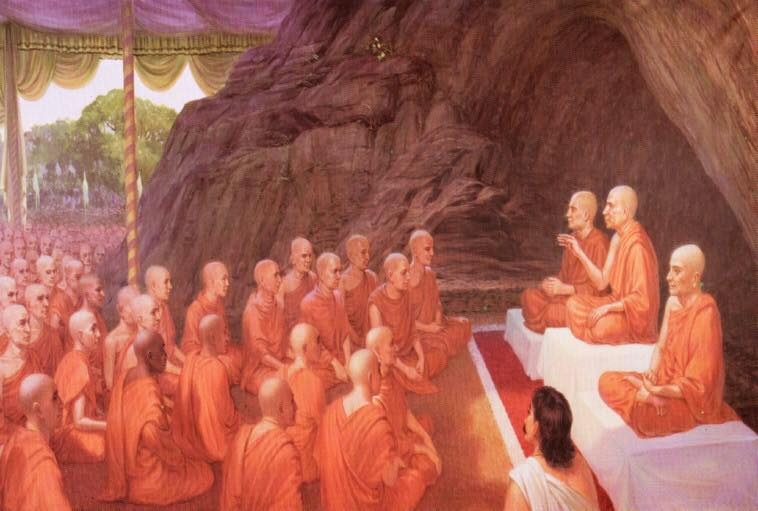
The story about the injustice of Mahā Kassapa seems to have appeared a long time ago; until now, some people say that he is a conservative and rigid person or use some equivalent words to show their ideas about his unemotion in solving Ānanda’s problem. We will discuss the ideas after reviewing the historical story between Mahā Kassapa and Ānanda that happened at the first sutta collection.
The Vinaya of Buddhism sects reports:
At the moment, while Venerable Mahā Kassapa and the monks were travelling from Pāvā Capital to Kusināra Capital, he said to the monks that when hearing the Buddha went into Nirvana 7 days ago at Kusināra Capital, some monks who did not cut off all of sensuality cried a lot. However, after the news was revealed, there was a monk named Subhadda who became a Buddhist in old age and was happy and said some evil words. He said to the other monks, “Oh my Sages, don't be upset, don't cry! We are now getting rid of the great Sramana. We have been bothered too much with his words about 'doing this or not doing that'. Now, we can do what we want and we do not do what we do not want”. (Mahaparinirvana Sutra).
To prevent the strong increase of illegal matters, Venerable Mahā Kassapa suggested that 500 Arahants should be selected from the monks to rebuild and chant Buddha Dharmas and the laws at Rājagaha capital. Venerable Upāli was chosen to rebuild and chant the law. Venerable Ānanda was chosen to rebuild and chant Buddha Drahmas)
Even though Ānanda was just at Srotapanna level, he was a monk who served the Buddha many years so that he could listen and memorize many Dharma and precepts from the Buddha. As the wish of the monks, Venerable Mahā Kassapa invited Ānanda to the first sutta collection. After that, he announced to everyone about selecting Rājagaha capital as a great percept to collect Dramas and laws during retreat season and informed all the monks who had no duty were not able to stay here.
One day before collection, Ānanda wonderred, “Tomorrow, the monks will start to collect Drama and precepts. If I join this great event with the monks in learning Arahant at a Srotapanna level, it is not suitable”. That night, he tried his best in practicing the Dramas with KĀYAGATĀSATI contemplation. When the morning was just dawning, he felt tired and wanted to lay down; at the moment, he was in total extinction of defilements and achieved Arahant enlightenment.
At the sutta collection day, after Venerable Upāli read the law and Venerable Ānanda read Buddha Drahmas, Ānanda informed Venerable Mahā Kassapa that the Buddha allowed the monks to skip the small and unimportant points. However, he did not ask the Buddha what they were.
Then, the senior monks asked Venerable Mahā Kassapa to bring up Ānanda’s dukkata for Ānanda to repent. Those things are:
The first one: Did not ask the Buddha what the small and unimportant points were.
The second: Stepped on Buddha’s cloth while sewing.
The third: Let a woman be the first one who paid homage to the physical body of the Buddha and dirtied the Buddha’s body with her tears.
The fourth one: Did not ask the Buddha to stay abode in human existence for one more life.
The fifth one: Asked the Buddha to allow women to enter the Sangas.
The sixth one: Did not bring the Buddha water even though Buddha has asked 3 times.
The sixth one existed in Mahīśāsaka-vināya, not in The Vinaya of Buddhism sects.
Venerable Ānanda himself felt no guilt and replied to the Arahant Sangha that:
The first one: Because he did not pay attention, he did not ask the Buddha about the small and unimportant points.
The second: He did not step on the Buddha’s cloth on purpose. Just because it was too big and no one helped me carry in the windy weather.
The third one: He let a woman be the first one who paid homage to the physical body of the Buddha because she had to go home before it got dark.
The fourth one: he did not ask the Buddha to stay in human existence for one more life because the evil’s obsession made him forget.
The fifth one: Because Mahā Pajapāti was the Buddha’s adopted mother, Ānanda asked the Buddha to allow her and other women to enter the Sangas.
The sixth one: At the moment, he could not take the Buddha water because there were 500 wagons crossing the river.
People felt disgruntled and supposed that Venerable Mahā Kassapa was a conservative and rigid person because of their points of view.
Comments:
Argument 1: Actually, Venerable Mahā Kassapa had stayed at Pāvā capital for a long time but he did not know about the matters that people speculated about Ānanda before the sutta collection. To run a congress, you can not just do anything you want to do but it requires discussion and calculation of the organization in all stages.
Furthermore, during the congress preparation, Venerable Mahā Kassapa and representatives of 498 Arahants heard speculation about the conduct as well as the eligibility of Ānanda in attending the sutta collection. They thought that Ānanda made mistakes and was not worthy to attend the first sutta collection because he had not got Arahant enlightenment and also because of the 5 (or 6) points mentioned above.
Argument 2: Venerable Mahā Kassapa and 498 delegates who attended the first sutta collection were Arahants. So they all knew for sure that Ānanda was not guilty. Besides, as an Arahant, they can not be partial, praised, blamed or ignorant of the Buddha’s Drama and laws. So, they can not blame or punish Ānanda.
Argument 3: Conclusion from the above 2 arguments. Venerable Mahā Kassapa and representatives of 498 Arahants questioned Ānanda about the points that people considered being wrong in order to vindicate him. Many people will take the view that Ānanda made dukkata so that what he said is not believable. It is the disadvantages of learning Buddha’s Dharma and laws to people who lack belief.
What the Arahants had done was to help Ānanda avoid people’s blame afterward.
Temporary ending:
Do Venerable Mahā Kassapa and representatives of 498 Arahants hate or love Ānanda? Do they have understanding? Are they conservative, rigid and jealous of people's sayings or not? We can see the answer through the arguments. Moreover, when slandering and rejecting the Arahants, we are collecting very heavy bad karmas, not ordinary karmas. Hoping everyone be careful in words and actions.
The injustice in a thousand years which still remains in some people’s minds has been nearly twenty six centuries since the first sutta collection. Venerable Mahā Kassapa with the best knowledge about Dhūtaṇga virtue was very serious in practicing Sramana dignity to become an example for posterity. Although the information about him in the sutras is not as much as the information about Sāriputta, Moggalāna or Ānanda, we can not underestimate the image of Venerable Mahā Kassapa. In the view of the writer, Venerable Mahā Kassapa is the one who is truly understanding and very impressive. Maybe, through this story, we should take him as an example in our diligent cultivation and in compassion for posterity, shouldn’t we?
Tâm Cung
Translated into English by Nguyen Khanh Hoa