
Wednesday, 10/21/2026
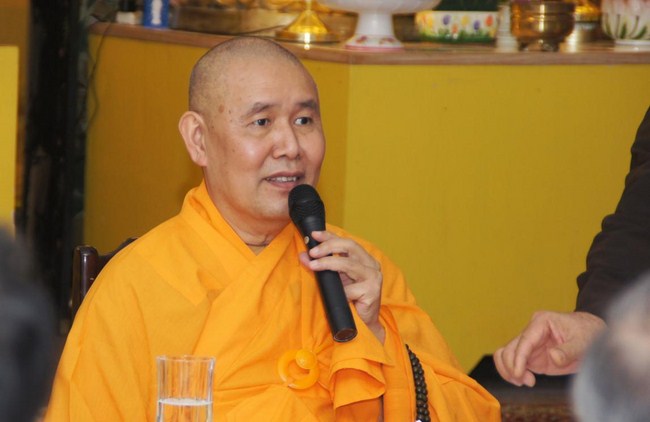
Venerable Thich Nhu Dien
Reading has been my consistent pleasure since school age. As long as I feel it interesting, I can read the whole book of 500 – 600 pages in just one or two days. For difficult contents, it takes me longer time reading piece by piece of the book. And… what does uninteresting book mean? In short, it is the incompatible ones to reader.
When writing a book, the writer for sure will try his/her best to serve the fine and unique content to readers; hence it impossible to mark any books the “badâ€. After all, that a book is valued interesting or uninteresting depends on writer/ reader’s feelings and willing to the book. I sometimes read Nikaya Sutra up to 200 pages (full of words) per day without any tiredness. Several times, I was reading when the night fell and I had to regretfully close the book wondering if I could have the same good mood when continuing it on the next day.
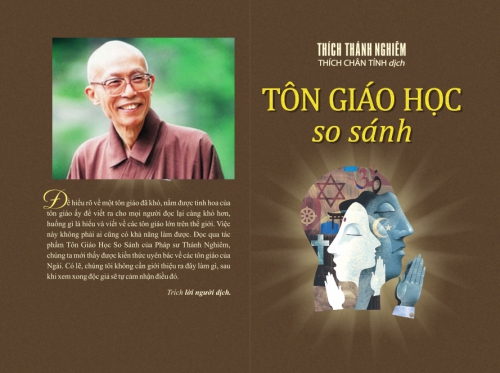
Any presents and donations are so precious for me, a monk, to receive with gratitude in which sutras are most valuable. Regardless how far it is or how heavy they are, I always manage to bring all given books back to my location without missing any one. In my opinion, it took people lots of labor and effort to prepare a suttra preaching Dhamma, we just have to spend time reading to extract the benefit. It would be regrettable and unreasonable if we do not spend our time reading those books due to laziness. Recently, I have just got 3 books, presented to me by the writer, Venerable Thich Chan Tinh, abbot of Hoang Phap Pagoda, dated on Nov 10th, 2015, via a Vietnamese expatriate during his trip back to Vietnam, his homeland. The first one was Religious Comparation Studies, also the title of this article, the second one was: King Prasenajit. And the third one was Flower Words, a Vietnamese-​English bilingual calligraphy book, which I read fast through poets.
The second book is a collection of stories about King Prasenajit and Buddha from Great Nikaya Sutta which I have already read in: DÄ«rghÄgama, MÄdhyamÄgama, SaṃyuktÄgama and EkottarikÄgama. Hence it was not necessary for me to reread them.
Particularly with the book "Religious Comparation Study" of the late Venerable Sheng Yen, I paid lots of attention and I read it at once. The book contained 624 pages with hardcover, presented in a clear and intelligent presentation from content to notes with nearly zero typo. This is a way to respect readers as they not only search for beautiful literariness or honest from the book but also the peace, joy of meeting with a valuable work. In this writings, both author and translator have met all those requirements.
Via the book foreword from the late Venerable Sheng Yen, we can see this book was fulfilled in April 1968 in Taipei, Taiwan. This is the collection of the author’s texts for his teaching as a lecturer to clergy students in Shoushan Buddhism Academy, Kaohsiung. Ven. Thich Chan Tinh completed the translation Chinese-Vietnamese in October 1995, first edition in 1996, second edition with adjustment in 2015 printed in Taiwan, with excellence in both form and content.
This book contains 10 chapters including 1) The dawn of religion in the world, 2) Religion of primitive tribes, 3) Religion of ancient peoples, 4) Religions of Indian, 5) Religions of China, 6) Minority Religions, 7) Judaism, 8) Christian, 9) Muslim, 10) Buddhism. Each chapter contains different sub-titles. The author has skillfully analyzed religions, one by one, on the scholar’s perspective instead of a Buddhist’s one. This is such a great work of religions comparison that I have ever read. Historically, Ven. Sheng Yen has clearly demonstrated with documents, as well as language, culture, etc ... For example, why English calls China instead of its original name Chung-kuo? The reason was: during the Chin (Qin) Dynasty, foreigners came to trade with this country and called it China which was much easier to pronounce than the word “Chinâ€.
The writer had a very good knowledge of Taoism; pointed out which part of Tao Te Ching were from Buddhism beliefs. Why Taoism and Confucianism, once developed well in China, can not go globally as Buddhism.
He also described clearly in Page 579 that "In the 10th year of Dynasty Emperor Wu (Sun Quan), Khuong Tang Hoi, a Vietnamese Zen Master came to the Jianye, Wu’s capital, and prayed for the Buddha’s relics appearance to inspire Emperor Wu’s good faith. As a result, the King built temple Kien So, the first pagoda in the state of Wu, for Monk Khuong Tang Hoi doing the worship activities and preaching Dhamma. Further more, Zen Master Khuong Tang Hoi translated and edited Liu Du Ji Jing Sutta from Pali as well as given notes and explanation to other available suttas which had been translated into Chineses previously. Thanks to that, Buddhism in Jiangnan got strong growth ..." Reading the above mentioned paragraph, we are proud of Vietnam, because His Excellency Khuong Tang Hoi, an ancient Zen Master Buddhist born and raised in Viet Nam went to Jiangnan, China to preach Dhamma and translate suttas making the then King and Government admire and devout that they built pagoda and gave him permission for religious worship activities ... Based on this book we can see hard and serious efforts from Ven Sheng Yen. The historic information in this book is also compatible to Prof. Tri Sieu Le Manh That’s book "Vietnam Buddhism History Volume I". During the history, there have been lots of great Tripitaka Sanskrit- Chinese translators, among those there were four excellent Tripitaka Master: Kumarajiva, Amonghavajra, Paramatha, and Xuanzang.
Regarding Hinduism, the writer’s analysis has been wide and deep with details of how meditation and vegan spread from Hinduism to Buddhism. The revolution of cosmological perspective and worldview on the formation of universe from the viewpoints of Hindus and Buddhism, similarities and differences.
The original of titles as Shakya Sramana, Brahmana Sramana, Pagan Sramana... After all, he suggested the name Bhikkhu given by Buddha, instead of Shakya Sramana; to distinguish to Hinduism clergy titles.
He wrote about the Ancient Arabic Religions and Prophet Mohamed; which beliefs of Islam came from Judaism, the differences of heaven described in Islam/Christian/ Judaism Heavens. Why Prophet Mohamed, who had married totally 7 wives after his first wife died at the age of 65 when he was 50, advocated polygamy? All of these issued have been explained in this book. Please be noted that this book has meticulously been compiled and published in Taiwan since 1968, for nearly half a century.
Recently the issue of religious wars, especially in the Arabic land with so much constant aggression, killing and brutally massacred, that many people to pay attention and would like to study about its reasons, why and what, via scriptures and policy. You will see this book has answered most of the concerns and queries.
Regarding the view of Buddhism, the writer does not write based on the monk’s subjective opinion but using the Buddhism viewpoint, debates and philosophy to discuss as a scholar. He said the theory of the Four Noble Truths, the Eightfold Path, and Twelve Causes and Conditions, the 37 Bodhipakkhiya-dhamma as Satipatthà na sutta with quaternary mindfulness (of body, feeling, consciousness, and mental objects), Catu Samma PadhÄna, Caá¹á¹Ära-iddhipÄda, PañcÄnÄm IndriyÄṇÄm, PañcÄnÄṃ BalÄnÄm, 7 factors of enlightenment, in which Three Dharma Seals are emphasized. This is the basic doctrine that Buddha has taught about : impermanence, Non-self and Nirvana…v.v. The writer has explained clearly in details how to practice to attain the levels of sravakas, pratyeka-buddha, Bodhisatva, Buddha…v.v. Via 4 events of disciples’ meeting for Sutta collection in India, he explained:
* How different Buddhism sects were formed as well as how sthaviravÄdin dominated mahÄsÄá¹…ghika in the 2nd meeting of sutta collection in Vesà li; 100 years after Buddha Parinirvana.
* Why there were only 500 individuals among numerous Arahants at the first sutta collection in Saptaparni – RÄjagaha Capital, 100 days after Buddha Parinirvana? According to Ven. Sheng yen, may be Mahacasyapa, Buddha’s great disciple, a dhuta and meditative practitioner, would like to invite the his comrades to join for the consistent in sutta collection. While other Arahants with Mahayana trend; specialized in studying and serving for the benefits of sentient beings were excluded. This is a reliable reasoning from the writer.
* Then Buddhism (Mahayana) went beyond India and the third sutta collection was carried out after Buddha Parinirvana 300 years, thanks to the support of Ashoka, the then Indian Emperor. Besides, without the supports of great masters as Nagarjuna, Asvaghosa, Asaá¹…ga and Vasubhandu, who were MÄdhyamika practitioners advocating emptiness and Mahayana trend, Buddhism would have not been able to spread globally. Especially the “5 arguments about Arahantship†of MahÄdeva has been discussed in the 3rd Sutta collection.
Overall, this is a wonderful and helpful writings in term of international religious study that professors/lecturers should introduce for students’ reference. I strongly believe that this work has already been translated into English. Hope that other religions’ belivers also have a look at it. If you are the one who would like to study about religions’ origin then this book is an intergral one in your bookcase.
Again, I would like to praise Ven. Thich Chan Tinh, a skilled writer who can delivery the thoughts of Ven. Sheng Yen via his translation. This merit is not small at all. Thank you very much Ven. Thich Chan Tinh.
Particularly to readers, those who would like to study, it’s time for you to open the book to read and contemplate word by word, page by page ... so that you can share your thoughts and feelings after reading through the whole 624 pages of this book. When closing the book, you can see it the avatar of Master Sheng Yen, a tiny man with wonderful wisdom. Finally, my own desire is: hope that you can absorb this book in various perspectives for your own and others’ benefits. Religion, up to now, still plays an important spiritual role in the faith of people on this planet.
I myself, when directly keeping in touch to the Western religions, have opinion as following: Every religion is more like the scent of a kind of beautiful flower. Catholic as Roses; Christian as Carnation; and Buddhism as Lotus. For years, we have planted them exclusively in separate gardens. Now it is time for us to plant them together in a spiritual garden so that we can have the colourful beauty blossoming, offering multi-fragrances to human beings. Amen (Please be as such).
Completed in a spring morning at temple room Park, Hannover, Germany on March 3rd, 2016.
Source: http://viengiac.de/2016/03/ton-giao-hoc-so-sanh/
Venerable Thich Nhu Dien