
Saturday, 10/03/2026
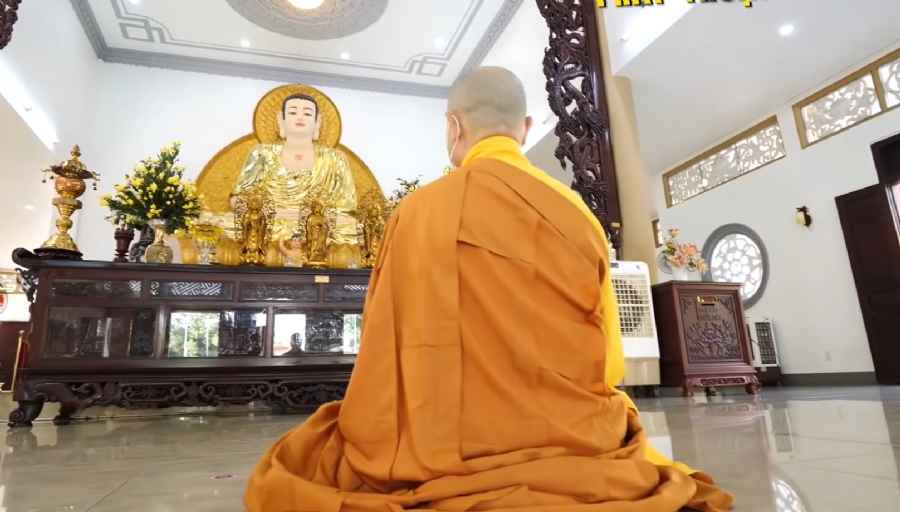
“Breathe into Namo A
Exhale Amitabha Buddha
Mindfulness and breathing are unified
Pure Bliss is this moment.”
The verse was introduced by Mr. Phong An - a Buddhist who went to the pagoda - and advised us to practice according to this method. We ourselves, after listening to him reading the poem, felt both strange and interesting. It's strange because up until now I've never heard of Buddha recitation combined with breathing. It’s interesting because the content of this verse is a very practical message. After a while, we had the opportunity to be given the book Flower Words, at that time the author's name was Thich Chan Tinh, the original master who transmitted Three Refuges and Five Precepts to us. “Ah! The above verse was written by our Master!” With joy, we silently practice reciting Buddha's name with our breath; then, for many years, we practiced it regularly in our daily activities.
I have a mild respiratory illness. During several years of practicing at the pagoda, when I went to the hospital for a general health check-up, the such disease no longer remained, and the doctor reported that my breathing was very normal and good. Is it possible that because I regularly "recite the Buddha's name with my breath", I have been able to regulate my breathing, improving my health?
Ajahn Chah, Thailand Zen Master also teaches how to recite Buddha's name according to the Southern Buddhist tradition, which is to recite Buddha's name with the virtue of the title "Buddho" and combine it with breathing in and out like “breathing in and reciting Bud... breathing out and recite...dho. Buddho” - read by Thai people as "But tho". According to Indians and Sri Lankans, it is read as "But do", with the word "do" pronounced very lightly.
Talking about breathing, there are many orthodox and post-orthodox methods that teach a lot. The same goes for Buddha recitation. However, the method of reciting Buddha's name through breathing that we know only appears somewhere in Vietnam, Thailand and a few in Taiwan.
Why is that?
According to traditional practice, we still like to make clear distinctions that reciting Buddha is purely reciting Buddha, and following the breath is purely following the breath. Traditions believe that uniformity in practice will lead to concentration and clearer results.
In fact, we ourselves do not have enough knowledge and practice level to determine or judge whether this issue is right or wrong. We just give the facts we know for everyone to do research.
For us, the practice of Buddha recitation has become a habit so that when we are confused and distracted, we can return to the "concentration" of reciting the good and noble Buddha without wandering around in unwholesome dharmas. Here, I use the word "concentration". I myself do not dare to use the words "mindfulness, concentration and wisdom" because my practice has not yet reached its goals. Practicing breath is also a regular daily topic that we think we should practice. In the sutra "Mindfulness of inhalation and exhalation", the Buddha taught 16 ways to observe the breath. Let us take 2 temporary examples, "Feeling the whole body, I will breathe in (out), then he practices” or “contemplating impermanence, I will breathe in (out), then he practices” … etc. It means that the Buddha also taught us to practice mindfulness, contemplating an object in the present accompanied by “breathing in, breathing out".
We return to Buddha recitation.
Northern Buddhism often recites the Buddha's name like Namo Amitabha Buddha, with the meaning:
+ Namo: refuge.
+ Amitabha: is Amitābha, immeasurable light (infinite light), implying immeasurable wisdom; or Amitāyus, immeasurable lifespan, implying only immeasurable concentration.
+ Buddha: Great Enlightenment - self-realization, awakening of others, perfect enlightenment.
With this profound and noble meaning, breathing in and out combined with the Buddha recitation - Namo Amitabha Buddha is a means based on the method that the World’s Honored One taught in ancient times- Buddha recitation and breathing are unified in the sutra "Practice of Mindfulness and breathing in and out".
Depending on the fundamental ability, level and interests, each person will have a suitable method of practice for themselves. This article gives our subjective opinion; however, it still bases on some verifiable facts.
Wishing everyone to be peaceful and wholehearted in their practice!
Tâm Cung
Translated into English by Huynh Thi Khanh Phung