
Friday, 10/09/2026
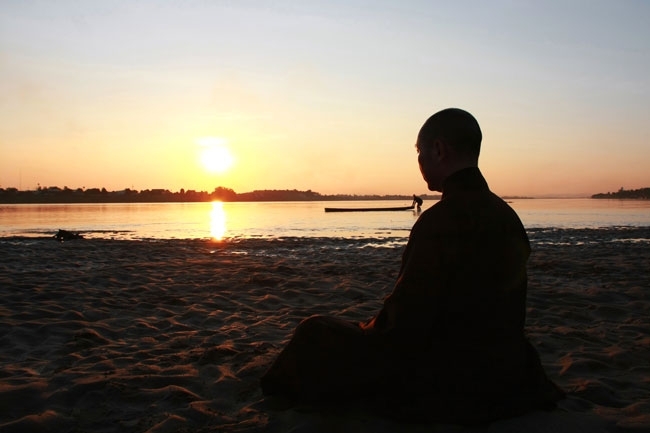
In today’s society, more and more people are coming to the temple, which is a hopeful sign for Buddhism. Yet each person’s purpose in going differs. Some come to pray for wealth, health, or love. Some come to find relaxation and peace after hours of study and work. Others come to learn the Dharma and to practice the Buddha’s teachings under the guidance of monks and nuns.
In our age, material comforts dominate, and people often become attached to them. This attachment gradually drives an excessive pursuit of wealth, fame, and social status, creating pressure on both body and mind. Because of this, many people seek the serenity of the temple, where their body and mind can rest. In the brief time they spend there, they may temporarily forget life’s worries and sorrows, letting their spirits settle into the quiet and stillness of the monastic space. Sometimes they also join in volunteer work, and by giving, they find a lot of joy.
However, when it comes to true practice, there is more to consider. A person without even a little understanding of the teachings will find it difficult to apply the Buddha’s words in the sutras, and may easily stray into non-Buddhist practices. Even those who have studied the Dharma to some degree may not necessarily experience peace. Why? Because if one only learns theory without bringing it into practice, it is like a patient who holds a prescription but refuses to take the medicine; or like someone holding a map who never walks the path he will never reach the destination.
The practice that the Buddha taught must be grounded in the principle of the Four Right Efforts (Samma Vayama), part of the Noble Eightfold Path. These are four aspects of diligence:
Our daily cultivation is to make wholesome states in our body and mind increase, while reducing the unwholesome. When unwholesome states are reduced until nothing remains to abandon, then we attain sainthood, we attain Buddhahood.
As mentioned earlier, when at the temple we feel happy because we are away from worldly affairs. But when we return home and face unexpected difficulties, how can we sustain that happiness? We read the scriptures, we grasp the methods of cultivation, and we try to apply them, yet sometimes the results are lacking. Why is this so? Because many people allow wholesome and unwholesome states to coexist and grow side by side. Depending on the strength of one’s karma, the current of good or evil will dominate, even though both are present together.
The practice of cultivation should be grounded in the truth of one’s own mind; only then can karma be transformed swiftly. The Buddha once gave the following teaching on the Dharma visible here and now, which brings immediate results.
A Brahmin said to the Blessed One:
“The Dharma is said to be visible here and now, Venerable Gotama. To what extent, Venerable Gotama, is the Dharma visible here and now, timeless, inviting one to come and see, leading upward, to be realized by the wise for themselves?”
The Blessed One replied:
“Overcome by craving, defiled by anger, clouded by delusion, brahmin, one’s mind is seized and dominated. Thus, he thinks of harming himself, of harming others, of harming both, and he experiences mental pain and grief. But when craving, anger, and delusion are abandoned, he no longer thinks of harming himself, of harming others, of harming both; he does not experience mental pain and grief. This, brahmin, is the Dharma visible here and now, timeless, inviting one to come and see, leading upward, to be realized by the wise for themselves.”
(Anguttara Nikāya 3.53 - The Brahmin Sutta, Chapter of Threes, The Next Fifty Discourses)
We can take a simple example. Suppose while listening to the Dharma, something unpleasant happens perhaps like a child or grandchild forgets to press the button on the rice cooker. In that very moment, does anger arise? If anger does arise, can it be transformed into compassion? Looking closely, this shows that enlightenment is not attained merely by reading scriptures. The Buddha points out suffering so that we may recognize it. Only by recognizing suffering can we develop the aspiration to overcome it. In the end, the teaching is always about suffering, and the cessation of suffering.
The essential point is that we must cultivate to the best of our ability in every situation, whether in stillness or in activity. In meditation, in reciting the Buddha’s name, in chanting sutras at every moment we should plant wholesome seeds in our consciousness. Where there is goodness, evil cannot take root. When we read sutras or Dharma books, if our mind is wholesome, unwholesome thoughts will not arise. Above all, when our six senses come into contact with the six sense objects, we must draw forth the most wholesome qualities of the senses in relation to the world. That is, we cannot let greed, anger, and delusion run rampant. Otherwise, we become like those who merely “speak in vain”: knowing the words but not living the practice. True practice is not for display; its purpose is to purify and renew our own body and mind. Then, gradually, as afflictions lessen, the noble qualities of sainthood will naturally shine forth.
Tam Cung
Translated into English by Thai Nhuoc Don